Polished homework, shaky understanding: what the research found
In June 2026, economists David Strömberg, Victor Lei, and Yanhui Wu published a Centre for Economic Policy Research (CEPR) discussion paper. It followed 26,811 students in Grades 7 to 12 in one county in central China for 30 months. Students who adopted chatbots such as DeepSeek and Doubao showed this pattern:
- Homework scores rose 18%.
- Time spent on homework fell 30%.
- Closed-book monthly exam scores fell 20% within six months.
- Entrance exam results fell 18% to 24% after about two years.
The paper explains the split. About 80% of AI users showed an outsourcing pattern: very short completion times paired with high scores. Users who spent roughly the same time on homework as non-users lost little. A 2025 study cited in the CEPR column found that a tool giving direct maths answers cut closed-book maths exam scores by 17%.
What the study did not test
These were secondary students in China, so no one should quote 18% or 20% as a forecast for a Year 3 child. The paper does report larger losses among its junior students and its high achievers, which is reason enough to take the pattern seriously. The likely mechanism is simple at any age: when an answer arrives before the thinking does, the practice that builds memory never happens. The effects of AI on children’s learning depend on who does the thinking.
Is AI good for kids’ homework? Read the clock first
Homework is practice, and the clock shows whether practice happened. The South China Morning Post reported that AI users in the CEPR data cut homework time from 64 to 45 minutes.
The same signal shows up at the kitchen table. A Year 3 reading response that once took 25 minutes and now takes six, with better vocabulary than your child uses at dinner, deserves a friendly question: how did you work this out? An answer in the child’s own words means the learning happened. A shrug is useful information too.
AI in primary schools in Australia: what families are working with
Rules for AI and homework in Australia sit at several levels:
- National framework. The Australian Framework for Generative AI in Schools, released on 1 December 2023, applies across government, Catholic, and independent schools. It sets six principles. Each state, territory, and school decides its own classroom rules.
- Curriculum. The Australian Curriculum teaches about AI through content in mathematics and technologies from foundation to year 10, so children meet the topic at school, whatever the rules at home.
- School-run tools. Some departments provide their own: NSW public schools use NSWEduChat, and Queensland state schools use Corella. Ask your child’s school which tools, if any, it approves.
- Age rules. OpenAI’s help center sets 13 as the minimum age for ChatGPT and asks for parental consent from 13 to 18. Children in the early and middle primary years sit well below that line, so an adult should run any chat.
Is using AI for homework cheating in Australia?
It becomes an integrity problem when AI-produced work is handed in as the child’s own. Schools set their own expectations. For primary homework, the practical step is asking the class teacher what the policy is and whether AI help should be mentioned on the task.
AI homework rules for kids at home: three zones
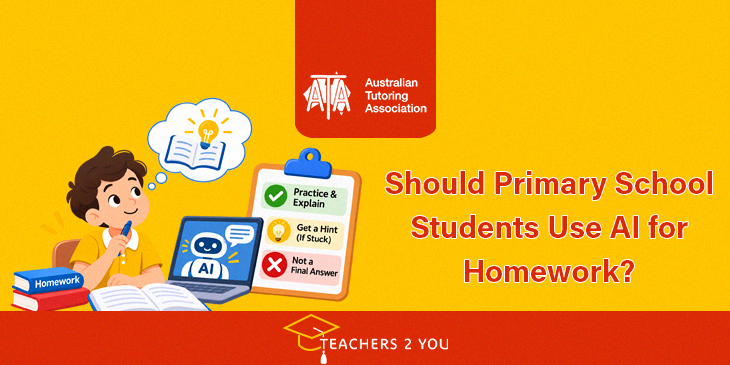
AI homework help for kids works when it sits in a clearly marked zone. Children using ChatGPT for homework meet a tool built for adults, so the adult holds the keyboard in every zone below.
Zone | What it looks like |
Green | After the day’s homework is finished, an adult asks AI for five extra practice questions at the child’s level or for a concept explained in plain words. |
Amber | The child has made a real attempt and is stuck. An adult asks AI for a hint that stops short of the answer, then the child continues alone. |
Red | AI writes sentences, supplies final answers, completes worksheets, or touches any task a teacher will assess. |
The Close-the-Book CheckRun this for three minutes after any homework that had AI anywhere near it:
- Close the screen and the book.
- Ask your child to explain one question aloud, as if teaching a younger cousin.
- Hand over a fresh question of the same type and let them solve it.
A pass shows the skill is there. A stumble marks the exact skill to revisit.
Year 3 homework help without AI works well with items already in the house. For multiplication, build arrays with pegs or pasta and ask your child to say the matching number sentence. For reading, ask for a three-sentence retell before any written response. These habits also suit Year 3 NAPLAN and Year 5 NAPLAN preparation, because students sit NAPLAN independently under test conditions.
How to stop kids using AI to do their homework
- Move homework to a shared space such as the kitchen table, and keep the first attempt screen-free.
- Agree one rule in advance: attempt first, then ask.
- Ask to see working, crossed-out ideas included. Crossing out is evidence of thinking.
- Give the reason: homework builds a brain that can do the task on test day.
- Send the class teacher a quick note when homework looks too polished to be real. The teacher can then adjust how tasks are set.
Where a qualified teacher fits
Polished homework can hide a learning gap for weeks, because the final answer looks the same either way. Spotting the gap takes a teacher looking at the child’s work.
Teachers2You offers one-on-one online tutoring for Years 1 to 12, delivered by qualified Australian teachers who currently work in Australian schools. Tutors are matched by year level, subject, and the child’s needs. In a session the tutor watches the child think, so the distance between what the homework shows and what the child knows becomes visible and fixable. A qualified teacher can find where understanding stops, which frees you from diagnosing it yourself.
For parents looking for homework help for primary school students that builds the skill itself, the how it works page shows the process. Your child works with the same tutor from session to session, and session notes and recordings sit in the Teachers2You Workspace for review between sessions. There are no lock-in contracts. See why families choose Teachers2You and how personalized learning shapes each plan.
Book a free consultation to talk through your child’s year level and where homework has started to feel uncertain. Contact Teachers2You.
The short version: AI in a small, supervised role
Yes, in a small, supervised role with the child’s own thinking leading. Fast, polished homework is a poor measure of learning, and the Close-the-Book Check gives you a better one. If the check shows gaps, a conversation with a qualified teacher is the logical next step.
FAQs
- Should primary school students use AI for homework?
Yes, but in a small role. For primary students, AI works as a short, adult-run explainer after the child has tried the work. Letting AI produce answers lifts homework scores while understanding slips.
- Should my child use ChatGPT for homework?
OpenAI sets 13 as ChatGPT’s minimum age, so primary-aged children should only use it with an adult running the chat. Use it once your child tries the work, to explain an idea, or to hint at the next step. - Is AI good for kids’ homework?
It depends on who does the thinking. A CEPR study of 26,811 Chinese secondary students found AI raised homework scores 18% but cut closed-book exam scores 20%. Let AI explain and let the child answer.
- How much AI use is okay for primary school students?
No official limit exists. A practical guide is occasional, adult-run use for a few minutes on one sticking point after the child’s own attempt, then a quick check that your child can explain it alone.
- Is using AI for homework cheating in Australia?
It can become an integrity issue when AI-made work is handed in as the child’s own. Each Australian school sets its own rules, so ask the class teacher whether AI help is allowed or needs to be noted.
- How can I stop my child using AI to do their homework?
Keep homework in a shared space, make the first attempt screen-free, and agree on the first attempt, then ask. Check the working and crossed-out ideas, and explain why: homework builds skills for test day.
- What are safe AI tools for primary school homework?
The safest tools are those your child’s school provides and approves, such as NSWEduChat in NSW public schools. For other chatbots, check age rules, stay with your child, and withhold personal details.
- What are the effects of AI on children’s learning?
Evidence on primary-aged children is still limited. Research on secondary students links answer-giving AI to lower exam results, while students who kept homework time similar to non-users lost little.
- What is good Year 3 homework help without AI?
Use items around home. Build multiplication arrays with pegs or pasta, then ask your child to say the matching number sentence. For reading, ask for a three-sentence retell before any written response.
- When should I get a tutor for my child’s homework struggles?
Consider a tutor if homework looks polished but your child cannot explain it alone, or if gaps keep returning. A qualified Australian teacher can find where understanding stops and rebuild from there.