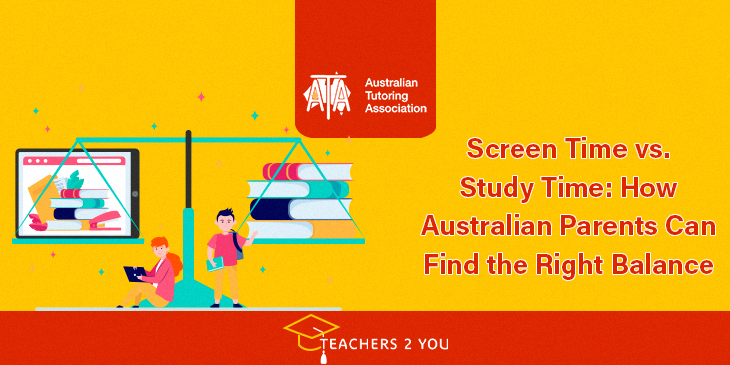
How much screen time is considered healthy for students?
The Australian 24-Hour Movement Guidelines (produced by the Australian Government Department of Health) recommend no more than two hours of recreational screen time a day for children aged 5 to 17, on top of time spent on schoolwork. That's a guideline, not a hard rule, and it doesn't distinguish between scrolling and, say, a video call with a tutor.
What matters more than the total number is what the screen is replacing. Two hours of gaming after a full day of school, sport, and homework look different from two hours of gaming instead of sleep, meals, or study.
A few markers worth watching:
- Sleep is shifting later. Devices in the bedroom after 9 pm are one of the most common disruptors parents report.
- Homework takes longer than it should. A 20-minute worksheet stretching to an hour usually means attention, not time, is the real shortage.
- Screens fill boredom automatically. If a spare ten minutes always defaults to a phone, that's worth a conversation, not a punishment.
Why this feels harder for Australian families in 2026
Most Year 5 to Year 10 students now do at least part of their schoolwork online: research tasks, submitted assignments, class portals, and group chats for group projects. That makes "just cut screen time" a genuinely confusing instruction. You can't ban the tool your child is meant to be using for study.
This is where a lot of well-meaning screen time advice falls short. It treats all screen use as equivalent when a Year 8 student researching an essay and the same student watching gaming streams are doing completely different things with the same device.
The more useful question isn't "How do I reduce screen time?" It's "How do I help my child tell the difference between screen time that serves them and screen time that just fills the gap?"
| Know more, How to Support Your Child’s Literacy Development at Home
Screen time guidelines Australia: what's actually recommended
Beyond the two-hour recreational guideline, the Department of Health's broader 24-Hour Movement Guidelines frame screen use as one part of a daily balance that also includes physical activity and sleep. For primary-aged children, that generally means:
Age group | Recreational screen time | Sleep recommendation |
5-12 years | Under 2 hours/day | 9-11 hours/night |
13-17 years | Under 2 hours/day | 8-10 hours/night |
Two things to note. First, these figures cover recreational use only, not schoolwork or tutoring sessions. Second, they're a national baseline, not a target to hit exactly. A household with a lot of outdoor sport on weekends has more room to move than one where screens are the main downtime activity.
Managing children's screen time without turning it into a daily fight
Blanket bans tend to backfire, mostly because they make the device more interesting, not less. A few approaches that tend to hold up better over a term, not just a week:
- Set the screen-free window before it's needed. Decide dinner-to-bedtime is device-free before the argument starts, not in the middle of it.
- Separate "earned" screen time from "default" screen time. Screens after homework is done feel different to a child than screens as the automatic first move after school.
- Keep chargers out of bedrooms. This one change does more for sleep than almost any other single rule.
- Model it. Children are aware when the no-phones-at-dinner rule applies only to them.
None of this needs to be rigid. Some weeks will slip. What matters is the pattern over a month, not any single evening.
Best study schedule for school students: building a routine that actually sticks
A study routine works when it matches how attention naturally runs down, not when it forces a fixed block of time regardless of how the child is coping.
For primary school students, shorter is usually better: 20 to 30 minutes of focused work, then a proper break. Secondary students juggling multiple subjects tend to benefit from a rotating structure rather than a single long session:
- Block 1 (20-40 min): the subject that needs the most mental energy, done first
- Break (10-15 min): away from screens, ideally outside or moving
- Block 2 (20-40 min): a second subject or task
- Wrap-up (10 min): checking what's done, what's left for tomorrow
The wrap-up step gets skipped constantly, and it's often the most useful five minutes of the whole session. It's the difference between homework that ends and homework that just stops.
Study environment at home: the physical setup matters more than it gets credit for
A study routine can be well-designed and still fail if the environment fights against it. A kitchen table with a TV on in the next room, a phone face up beside the laptop, and siblings walking through every few minutes: none of these are dramatic, but together they add up to constant low-level interruption.
A workable study space doesn't need to be elaborate. It needs:
- A consistent spot, used for study and nothing else, where possible
- The phone in another room, not just face-down
- Enough light to avoid eye strain (natural light where you can get it)
- A visible, physical reminder of what needs doing today
How to improve study focus when screens are part of the problem
Here's the part that surprises a lot of parents: the goal usually isn't less screen time overall. There are fewer switches between tasks. Every time a child checks a notification mid-worksheet, it takes real time and mental effort to get back to where they were. That cost is invisible, but it's the main reason a 20-minute task can stretch to an hour.
Practical focus supports that don't rely on willpower alone:
- Notifications off during study blocks, not just the phone put away
- One tab open for research-based homework, not five
- A visible timer, which gives the brain a clear endpoint to work towards
- Short, screen-free breaks, not scrolling breaks that just extend the switching cost
Study skills for students: the habits that outlast any single homework night
Screen management and study routines both work better once a child has a few core study skills in place, things like breaking a task into smaller steps, checking their own work before calling it finished, or knowing which subject to tackle first when energy is highest. These aren't habits most children develop on their own. They're usually built through repetition, with someone checking in and adjusting the approach as needed.
Study routine for Australian students: what this looks like day to day
Put together, a realistic weekday might look like this: school finishes; a genuine break with no screens; a snack; then one focused study block before dinner, followed by a second shorter one if needed; home reading; and a screen-free wind-down before bed. Weekends can flex more, with study moved earlier in the day so evenings stay open.
The point isn't perfection. It's a rhythm the household can actually repeat, week after week, without it becoming a fight every single time.
If schoolwork keeps stalling despite a decent routine at home, that's often less about discipline and more about needing a different kind of support, one built around how your child specifically learns. Teachers2You connects students in Years 1 to 12 with Australian-qualified, currently practising teachers for one-on-one online sessions built around your child's actual gaps, not a generic worksheet. Book a session with Teachers2You to see what a tailored study plan looks like for your child.
Frequently Asked Questions
- How much screen time should my Year 5 child have on school nights?
Government guidelines suggest under 2 hours of recreational screen time daily for ages 5–17, separate from schoolwork or study.
- Is screen time before homework a bad idea?
Not inherently, but it can make switching to focused work harder. Try short, screen-free breaks between school and homework instead.
- How do I get my teenager off their phone to study?
Set clear screen-free study blocks in advance, remove notifications, and keep the phone in another room, not just face-down nearby.
- Does using a laptop for homework count as screen time?
Guidelines typically separate recreational screen use from schoolwork. Focus on distraction risk during homework, not the device itself.
- How can I create a better study environment at home?
A consistent, distraction-free spot; a phone in another room; good lighting; and a visible task list make the biggest practical difference.
- What study skills should my child be developing?
Breaking tasks into steps, checking their own work, and knowing which subject to tackle first when focus is strongest are core, learnable skills.
- When should I consider a tutor instead of just adjusting screen time?
If homework avoidance continues despite a solid routine, the gap may be understanding, not discipline, worth exploring with one-on-one support.